







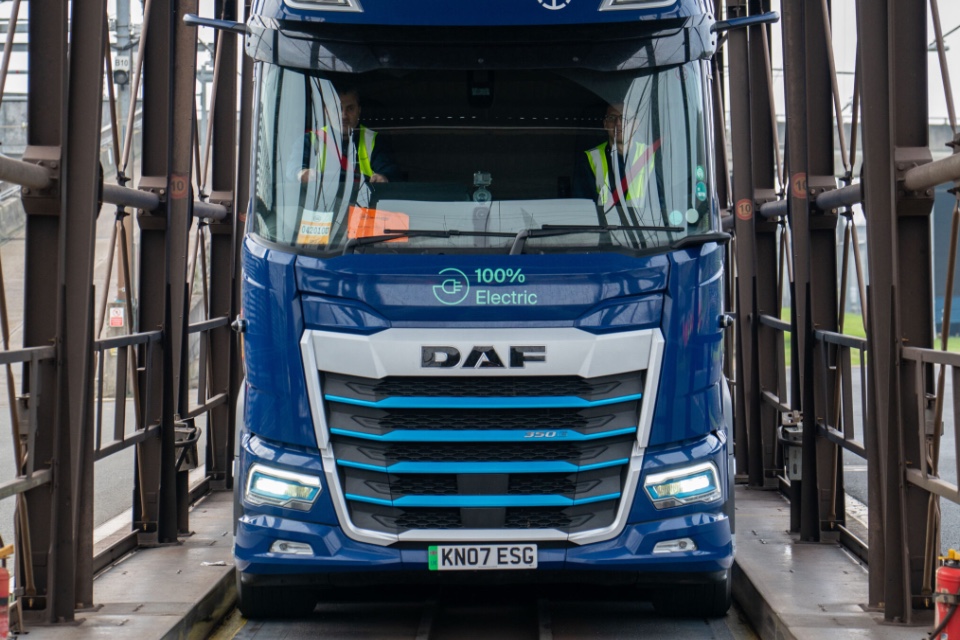
A battery-electric heavy goods vehicle has completed the first-ever freight journey through the Channel Tunnel using LeShuttle Freight, in a milestone that operators say demonstrates zero-emission road freight is becoming viable on one of the UK’s most commercially critical trade corridors.
The trip was delivered through a collaboration between Kuehne+Nagel, LeShuttle Freight (Eurotunnel), charging specialist Voltempo, and DAF Trucks. The partners say the successful crossing shows electric HGVs can be integrated into existing cross-Channel freight operations, with an operational model that is “ready to scale”.
Why it matters for fleet managers
Eurotunnel says LeShuttle Freight carries around a quarter of all goods traded (by value) between the UK and continental Europe, with over a million trucks using the service each year. For fleet managers planning international decarbonisation routes, the announcement reinforces that the tunnel’s all-electric shuttle service can form part of a zero-direct-emission corridor for eHGV operations.
Route, charging and infrastructure: what was proven
The vehicle departed Kuehne+Nagel’s East Midlands Gateway depot loaded with 12 tonnes of freight, then charged at the site’s new Voltempo HyperCharger installation, described as the UK’s first megawatt-scale eHGV charging system. The six-bay hub can deliver up to 1MW of power or dynamically share capacity across multiple trucks, a model that will be familiar to fleet operators thinking in terms of depot throughput rather than single-vehicle charging.
Across a 1,700 km round trip to Kuehne+Nagel’s depot in Haiger, Germany, the crew topped up at public high-power hubs including Gridserve in the UK and Milence sites in Dunkirk (France) and Maasmechelen (Belgium), highlighting the emerging practicality of multi-country charging plans for long-haul duty cycles.
Vehicle capability: DAF XF Electric
The milestone run used a DAF New Generation XF Electric, which has been recognised as International Truck of the Year 2026. The partners say the truck offers up to 500 km real-world range on a single charge and supports DC charging up to 325 kW, enabling “rapid top-ups” and making daily long-haul patterns more achievable when paired with the right charging strategy.
Government-backed learning through ZEHID
The project sits within eFREIGHT 2030, part of the UK government’s Zero Emission HGV and Infrastructure Demonstrator (ZEHID) programme, with the consortium set to share operational learning to help accelerate broader adoption. For fleet managers, that should translate into more real-world insight on route planning, charging dwell times, and cross-border operational constraints, areas where early deployments often struggle.
Industry voices framed the journey as a proof point that “range anxiety” for eHGVs on core supply routes is becoming less relevant as charging networks and depot hubs expand.